Executive Summary
The paper “Grid Flexibility vs. Gridlock: Microgrids Supporting Macrogrids” argues for transitioning from today’s centralized and increasingly strained electric grid (“Gridlock”) to decentralized, resilient, grid-flexible architectures built around microgrids. As infrastructure ages and energy demands grow, microgrids offer localized control, rapid response to disturbances, fault isolation, and efficient integration of Distributed Energy Resources (DERs).
Glossary of Terms
- DERs: Distributed Energy Resources
- BESS: Battery Energy Storage System
- ADMS: Advanced Distribution Management System
- DERMS: Distributed Energy Resource Management System
- OpenADR: Open Automated Demand Response
- SCADA: Supervisory Control and Data Acquisition
- IoT: Internet of Things
Grid flexibility also supports broader energy-transition goals. By enabling higher use of renewables such as solar and wind, microgrids help reduce greenhouse gas emissions. Their reliance on digital technologies including smart inverters, real-time analytics, and automated controls improves visibility, coordination, and overall system efficiency.
This paper is designed for a wide audience, including utilities, policymakers, regulators, developers, technologists, engineers, and energy consumers. It outlines the technical, operational, and regulatory challenges that currently limit microgrid adoption and provides a practical roadmap for scaling deployment.
Microgrid advantages offer:
- Localized control and grid resilience
- Renewable energy and battery storage integration
- Load balancing and peak shaving to ease grid stress and operational costs
- Scalable, modular deployment across sectors
Case studies in this paper related to microgrid architectures serving Blue Lake Rancheria, California and Onslow, Australia; analysis by the National Renewable Energy Laboratory; and others demonstrate measurable benefits in reliability, cost management, and emissions reduction.
To enable a flexible electric grid future, this paper emphasizes the need for aligned stakeholder engagement, interoperable and cybersecure technologies, specialized workforce development, clear performance metrics, and supportive regulatory and economic structures. While initial capital costs can be high, microgrids have the potential to offer long-term savings and improved energy security. Grants, tax credits, and utility programs may further reduce upfront expenses.
Ultimately, a flexible electric grid represents both a technical evolution and a call for collaboration across the energy ecosystem to build a more resilient, equitable, and sustainable grid.
The Case for Gridlock
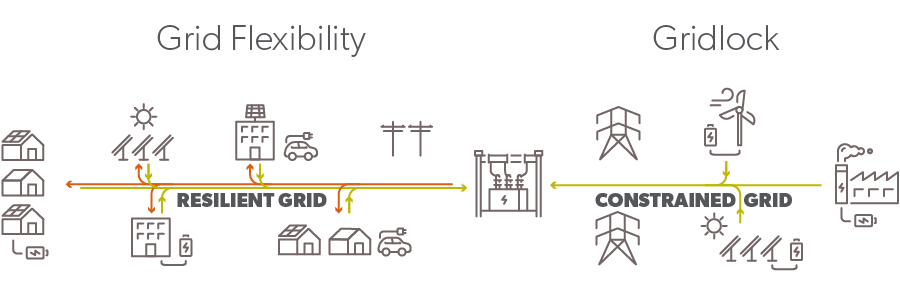
The traditional centralized electric grid model was designed during an era of predictable energy demand and limited generation diversity. Its architecture prioritized large-scale power plants transmitting electricity over long distances to consumers, with minimal flexibility or local control. While this model served its purpose for decades, it now faces mounting challenges that hinder its ability to meet modern energy needs.
One of the most pressing issues is transmission bottlenecks, where aging infrastructure and limited capacity restrict the flow of electricity, especially during peak demand or in regions with intermittent generation, such as renewables. Transmission system constraints can lead to considerable curtailment of clean energy, increased costs, and reliability concerns. Additionally, the centralized grid struggles with reliability and resilience. With several single points of failure, such as substations or transmission lines, the centralized grid is vulnerable to operational errors and potential attacks, which can lead to widespread outages.
The integration of local Distributed Energy Resources (DERs) poses another challenge. Centralized systems were not designed to accommodate bidirectional power flows or the variability of renewables like solar and wind, whose output fluctuates with changing sunlight, wind speeds, and other environmental conditions. As a result, utilities face technical and operational hurdles in managing DERs efficiently and safely. Compounding these issues are regulatory and operational constraints, with existing policies, market structures, and utility business models often progressing at a slower pace than new technologies and decentralized solutions.
Together, these challenges illustrate the limitations of the centralized grid and highlight the urgent need for a more adaptive, resilient, and distributed approach to energy infrastructure.
The Promise of Flexible Electric Grids
As the limitations of centralized electric grid infrastructure become increasingly evident, the concept of a flexible, decentralized electric utility grid architecture offers a compelling alternative. At the heart of these flexible approaches are microgrids, which serve as modular, scalable, and resilient energy systems capable of operating both independently and in coordination with the larger interconnected power grid or macrogrid.
- Localized Control and Resilience
Microgrids enhance grid resilience by localizing energy generation, storage, and distribution. In the event of macrogrid failures due to extreme weather, cyberattacks, or equipment failures, microgrids can isolate themselves (island) and continue to serve critical loads. This capability is especially valuable for critical infrastructure such as hospitals, military bases, and data centers, and can be implemented in communities located in disaster-prone regions. - Seamless DER Integration
Microgrid designers strategically integrate DERs such as solar photovoltaic (Solar PV), wind turbines, battery energy storage systems (BESS), and even electric vehicles to create efficient, high-performance energy networks. By managing these resources locally, microgrids not only reduce the strain on transmission and distribution infrastructure, but also enable more efficient use of renewable energy, inherently improving system efficiency. - Load Balancing and Peak Shaving
Microgrids can dynamically manage local demand and supply, helping to flatten peak loads and reduce the need for expensive peaking power plants. Through intelligent control systems, they can shift loads, store excess energy, and respond to price signals, contributing to overall grid stability and economic efficiency. - Emergency Support and Islanding Capabilities
In times of grid stress or emergency, microgrids can provide grid-forming services whereby they take on an active role in controlling and regulating the voltage and frequency of the electricity they deliver. Their ability to operate autonomously provides continuity of service for critical infrastructure while also offering support to the macrogrid during restoration efforts. - Scalability and Modularity
Microgrids are inherently modular, allowing for phased deployment and scalability. Communities, campuses, and industrial facilities can start small and expand as needs evolve, making this flexible approach a practical and economically viable pathway toward a more resilient energy future.
Microgrids in Action
Microgrids are no longer theoretical solutions; they are actively transforming energy systems across diverse sectors and geographies. Their deployment demonstrates how localized energy systems can enhance reliability, sustainability, and economic efficiency while supporting the broader macrogrid. From urban centers to remote communities, microgrids are proving their value in real-world applications.
- In Onslow, Australia,1 a solar-and-battery microgrid successfully powered over 800 homes for 80 minutes without fossil-fuel backup, maintaining stable frequency and voltage while operating in island mode.2 The system integrates a 600-kW solar farm, 700 kW of rooftop PV, and utility-scale batteries managed by advanced Distribution Energy Management Systems (DERMS) controls, enabling seamless transitions during grid disturbances and optimizing renewable generation. This architecture not only enhances resilience during outages and extreme weather but also reduces reliance on diesel fuel, cutting emissions and operational costs.
- According to National Renewable Energy Laboratory (NREL), hybrid microgrids achieve lifecycle cost reductions of 19% in New Mexico and 35% in Maryland compared to diesel-only systems.3 Industry data shows 20–30% annual energy savings, with payback periods of 3–7 years and return on investment exceeding 15% over the project life, driven by lower fuel consumption, reduced maintenance, and deferred transmission upgrades.
- In urban environments, microgrids are utilized to relieve stress on congested substations and improve overall reliability. For example, areas with high energy demand can deploy microgrids to manage peak loads and integrate rooftop solar, reducing reliance on centralized infrastructure. In rural and remote areas, microgrids offer a lifeline by providing reliable electricity where traditional grid extension is economically or logistically unfeasible. These systems often combine solar, wind, and battery storage to deliver clean, continuous power.
- Institutional campuses such as universities, military bases, and hospitals are also leveraging microgrids for energy independence and resilience. These facilities benefit from the ability to island during grid outages, providing uninterrupted operation of critical services. Additionally, industrial sites are adopting microgrids to manage energy costs, reduce carbon footprints, and maintain operational continuity during grid disturbances.
- In the case of mission-critical institutions in the United States, U.S. military installations illustrate how microgrids can deliver mission-critical energy resilience by reducing dependence on vulnerable centralized grids. In response to rising natural disaster and cyber risks, the Department of Defense (DoD)* is deploying microgrids that integrate renewables, storage, and secure controls to maintain essential operations during outages, while Army guidance emphasizes site-specific planning and resilient system design. These efforts show how institutional campuses can use microgrids to achieve reliable, independent power aligned with long-term security, operational goals, and broader energy-efficiency initiatives.
Each of these examples highlights the adaptability and effectiveness of microgrids in addressing specific energy challenges. As technology advances and policy frameworks evolve, microgrids will continue to play a pivotal role in shaping a more resilient and flexible energy future.
Equity and Access
Microgrids are especially impactful in underserved areas, including Indigenous communities and disadvantaged neighborhoods. They provide reliable, clean energy where traditional grid service is limited or unreliable. Programs that prioritize equity can enable benefits for communities from innovations that may accompany a distributed and interconnected grid, including but not limited to:
- Rural electrification and energy access
- Bill savings and general price stability
- Improved air and noise quality
- Greater energy independence
- New clean-energy jobs
- Community wealth building
- Educational benefits for youth and the community (e.g., institutional/community solar)
- Greater community resilience to disasters and power outages
An example of an equity-focused microgrid is the Blue Lake Rancheria (BLR) Indigenous community microgrid in Humbolt County, California, where a community-scale, low-carbon microgrid provides resilient, reliable power to a region historically impacted by frequent outages and limited grid reliability. By integrating 420 kW of on-site renewable generation and 1,150 kW/1,950 kWh of battery storage, the Indigenous community reduced energy costs, improved local air quality, and increased energy independence while strengthening emergency preparedness for disasters. The project also supports clean-energy job creation, keeps economic value within the community, and serves as an educational platform for Indigenous youth and regional academic partners, demonstrating how microgrids can advance community wealth building and long-term sustainability in underserved areas.
Learn more about our Power Delivery services, including:
Technical and Operational Integration
The successful deployment of microgrids within a flexible electric grid framework depends on robust technical and operational integration with the macrogrid. This includes advanced communication systems, intelligent control platforms, and secure interoperability protocols that provide seamless coordination between distributed and centralized assets.
Communication and control systems are the backbone of microgrid functionality. These systems enable real-time monitoring, forecasting, and decision making across DERs, loads, and storage units. Technologies such as grid monitoring systems (Supervisory Control and Data Acquisition [SCADA]), internet-connected devices (Internet of Things [IoT]), and edge computing allow microgrids to respond dynamically to grid conditions, optimize performance, and maintain stability.
Interoperability with the macrogrid is essential for maintaining that microgrids can both support and benefit from centralized infrastructure. Standards-based interfaces and protocols such as standard communication protocol (IEEE 2030.5)4 and Automated Demand Response Protocol (OpenADR)5 facilitate data exchange, control coordination, and facilitate grid services like frequency regulation and voltage support. This interoperability allows microgrids to participate in broader grid operations while maintaining local autonomy when needed.
The role of smart grid management tools, such as Advanced Distribution Management Systems (ADMS) and DERMS, is increasingly critical in orchestrating and managing the complexity of modern distribution networks. ADMS and DERMS platforms integrate real-time data, predictive analytics, and automated control to optimize grid performance. When integrated with microgrids and DERs, ADMS and DERMS enhance situational awareness, support DER orchestration, and enable proactive grid management.
Cybersecurity considerations must be prioritized to protect both microgrid assets and the broader grid infrastructure. As microgrids rely heavily on digital communication and control, they are vulnerable to cyber threats that could disrupt operations or compromise data integrity. Implementing layered security architecture, encryption protocols, and continuous monitoring is essential to safeguard these systems and maintain trust in decentralized grid operations.
Together, these technical and operational elements form the foundation for a resilient, intelligent, and secure electrical power delivery ecosystem that can support the adaptation of evolving energy demands and challenges.
Policy, Regulation, and Market Evolution
The transition from a centralized electric grid model to a decentralized, flexible architecture like that discussed here requires significant shifts in policy, regulation, and market design. While microgrids offer clear technical and economic benefits, their widespread adoption may be delayed or enabled by the regulatory environment in which they operate.
Regulatory barriers and enablers play a critical role in shaping the pace and scale of microgrid deployment. In many jurisdictions, outdated interconnection standards, established utility practices, and lack of clear definitions for microgrid operations create uncertainty and limit investment. Conversely, progressive policies that support DER integration, grid services compensation, and streamlined permitting processes can accelerate adoption and innovation.
Incentive structures and funding mechanisms are often needed to overcome the up-front capital costs associated with microgrid development. Federal and state programs, tax credits, grants, and public-private partnerships may help mitigate investment risks and make microgrids more accessible to communities, institutions, and businesses. Performance-based incentives that reward resilience, emissions reductions, and grid support services further align microgrid benefits with broader energy goals.
The role of utilities and third-party developers is evolving as microgrids become more mainstream. Utilities can function as facilitators, owners, or partners in microgrid projects, leveraging their expertise and infrastructure to support deployment. Meanwhile, third-party developers bring innovation, financing models, and customer-centric solutions that expand market reach and accelerate implementation.
Emerging business models, such as energy-as-a-service, are redefining how microgrids are financed, operated, and maintained. These models allow customers to benefit from resilient, clean energy without bearing the full cost or complexity of ownership. By bundling energy generation, storage, and management into a service contract, energy-as-a-service providers offer predictable costs and performance guarantees, making microgrids more attractive to a wider range of users.
Together, these policies and market dynamics will determine how quickly and effectively microgrids can scale to support a more resilient, equitable, and sustainable energy future.
Roadmap to an Evolved Flexible Electric Utility Architecture
Transitioning from a centralized electric grid model to a decentralized flexible electric grid architecture requires a strategic and coordinated approach. This roadmap outlines the key steps necessary to guide utilities, policymakers, developers, and communities toward successful implementation.
- Strategic planning and stakeholder engagement are foundational to any evolved grid initiative. Effective planning must align technical goals with community needs, regulatory frameworks, and long-term sustainability objectives. Engaging stakeholders including utilities, regulators, customers, and technology providers creates transparency, builds trust, and fosters collaboration across sectors.
- Technology deployment and scaling must be approached with both agility and foresight. Pilot projects can validate technologies and operational models, while phased rollouts allow for iterative learning and risk mitigation. Standardization of components, interoperability protocols, and integration with existing infrastructure are critical to scaling microgrids and DERs efficiently.
- Workforce development and training are key to supporting the evolving demands of a decentralized grid. Engineers, technicians, planners, and operators must be equipped with the skills to design, install, and manage advanced energy systems. Investment in education, certification programs, and cross-disciplinary training will support the development of a capable workforce ready to lead the transition.
- Metrics for success should be clearly defined and regularly evaluated. These may include improvements in grid reliability, reductions in carbon emissions, cost savings, DER penetration rates, and community resilience outcomes. Establishing performance benchmarks and feedback mechanisms enables continuous improvement and accountability throughout the transition process.
By following this roadmap, stakeholders can navigate the complexities of grid modernization and unlock the full potential of a distributed electrical infrastructure to create a more resilient, equitable, and sustainable energy future.
The Blue Lake Rancheria (BLR) microgrid project is an example of how this diversified approach roadmap can help a community come together to build a clean, reliable, and locally supported energy system. The BLR began with community-driven strategic planning through its Climate Action Plan and coordinated closely with state and utility regulators to align goals. Collaboration among the Indigenous community, Pacific Gas & Electric (PG&E), the Schatz Energy Research Center, and federal partners enabled transparent, cross-sector engagement. The project advanced through phased deployment, beginning with pilot installations of solar, storage, and a control system before expanding capacity. Workforce readiness was strengthened through technical training supported by the Idaho National Laboratory (INL). Clear metrics guided improvements, with the microgrid delivering documented gains in resilience, including maintaining power during regional outages, along with documented emissions reductions and cost savings.
The vision for a resilient, flexible, and sustainable future is within reach. By moving beyond the constraints of Gridlock and embracing the adaptability of an evolved electric utility system, we can build an energy system that meets the needs of today while preparing for the challenges of tomorrow.
Conclusion
The transition from Gridlock to a more flexible distributed energy production and delivery approach represents a pivotal shift in how we generate, distribute, and manage electricity. This white paper has explored the limitations of the centralized electric grid, the transformative potential of microgrids, and the technical, regulatory, and strategic pathways needed to realize a more flexible and resilient energy future. Microgrids offer localized control, seamless DER integration, and enhanced resilience, making them fundamental components of modern grid architecture.
Utilities, regulators, and communities must act decisively to embrace this transition. By updating policies, investing in enabling technologies, and fostering collaboration across sectors, stakeholders can accelerate the deployment of microgrids and unlock the full benefits of their integration and effects with the macrogrid. Strategic planning, workforce development, and performance metrics will be key to realizing long-term success.
The vision for a resilient, flexible, and sustainable future is within reach. By moving beyond the constraints of Gridlock and embracing the adaptability of an evolved electric utility system, we can build an energy system that meets the needs of today while preparing for the challenges of tomorrow.
Summary of Key Insights
- Gridlock describes the limitations of the traditional centralized grid, including congestion, aging infrastructure, and difficulty integrating DERs.
- An evolved flexible electric grid represents a decentralized, adaptive grid model enabled by microgrids that enhance resilience, flexibility, and sustainability.
- Microgrids provide localized control, seamless DER integration, load balancing, and emergency support, making them vital to modern grid architecture.
- Technical integration requires advanced communication systems, interoperability with the macrogrid, ADMS platforms, and strong cybersecurity.
- Policy and market evolution must address regulatory barriers, create incentives, and support new business models like energy-as-a-service.
- A strategic roadmap includes stakeholder engagement, scalable technology deployment, workforce development, and clear success metrics.
- The future grid must be resilient, flexible, and sustainable, driven by collaboration among utilities, regulators, developers, and communities.
Contact Jose Carranza, PE, 412.399.5069, or Stephen Anthony, PE, MS, 412.399.5364, more information about GAI’s electric grid enhancement and resiliency support, part of the comprehensive range of GAI’s engineering, environmental, and cultural resources services for power and energy projects.
 Jose Carranza, PE has more than three decades of experience managing initiatives that support modern electric grids and major energy infrastructure improvements including the planning of overhead and underground capacity expansions, reliability upgrades, and more.
 Stephen Anthony, PE, MS has over 20 years of experience specializing in managing power-delivery engineering projects, from distribution pole replacement to large, intricate, multi-year substation expansions.
Annotated Bibliography
Booth, S., Reilly, J., Butt, R., et al. (2019). Microgrids for Energy Resilience: A Guide to Conceptual Design and Lessons from Defense Projects (NREL/TP-7A40-72586). National Renewable Energy Laboratory.
Resource for discussion of microgrids as a resilience strategy for critical infrastructure; provides practical guidance on microgrid design and implementation, emphasizing resilience benefits and lessons learned from defense-sector projects.
Electric Power Research Institute. (2021). DER-VET™: Distributed Energy Resource Value Estimation Tool overview. EPRI.
Resource for discussion of cost-benefit analysis and optimization frameworks; introduces a valuation tool for distributed energy resources, enabling utilities and planners to assess economic and operational benefits of microgrids.
IEEE Standards Association. (2018). IEEE Std 1547-2018: Standard for Interconnection and Interoperability of Distributed Energy Resources with Associated Electric Power Systems Interfaces. IEEE.
Resource for discussion about interoperability and regulatory compliance for flexible electric grid architectures; defines technical requirements for DER interconnection, ensuring safe and reliable integration.
IEEE Standards Association. (2017). IEEE Std 2030.7-2017: IEEE Standard for the Specification of Microgrid Controllers. IEEE.
Resource for discussion of technical roadmap for flexible electric grid implementation; specifies functional requirements for microgrid controllers, critical for enabling autonomous operation and seamless grid interaction.
Marqusee, J., Becker, W., & Ericson, S. (2020). Resilience and economics of microgrids with PV, battery storage, and networked diesel generators (NREL/TP-78837). National Renewable Energy Laboratory.
Resource for case studies and ROI discussion, analyzes resilience and economic performance of hybrid microgrids, providing quantitative insights into cost savings and reliability improvements.
U.S. Department of Energy. (2024). Grid Modernization Strategy. Office of Electricity.
Resource for discussion of DOE’s vision for modernizing the U.S. electric grid, including distributed resources and advanced technologies, flexible electric grids as part of national modernization efforts.
U.S. Department of Energy. (2025). Distributed Energy Resource Interconnection Roadmap Interconnection Innovation e-Xchange (i2X). Office of Electricity.
Resource for roadmap to improving DER interconnection processes, discussion of reducing barriers to deployment recommendations for policy and regulatory reforms.
Electric Power Research Institute. (2021). Validated, Transparent, and Accessible Microgrid Valuation and Optimization Tool: DER-VET final project report. EPRI.
Resource for discussion of methodologies for microgrid valuation and optimization and emphasis on analytical rigor in planning flexible electric grid systems.
Bird, L., Walker, C., Womble, J., et al. (2024). Distributed Energy Resources as an Equity Asset. IEEE PES Volume 22 Number 4
Resource for discussion of how DER’s offer a unique opportunity to maximize the accessibility and availability of energy resources to disadvantaged communities in rural, remote, urban, and suburban contexts.
Curtis, S., & Rocha, P. D. (2024). Microgrids for the 21st Century: The Case for a Defense Energy Architecture. National Defense University Press.
Resource for discussion of how the Department of Defense (DoD)* is accelerating microgrid deployment to address vulnerabilities in the centralized grid, including natural disasters and cyber threats.
Pacific Northwest National Laboratory (2025). Microgrid Handbook for Army Resilience. U.S. Department of Energy.
Resource for discussion of Army guide for planning, designing, financing, and operating microgrids for energy security and resilience.
Blue Lake Rancheria, Narum et al. (2016). Developing a Low-Carbon Microgrid on Tribal Lands: A Case Study.
Resource for case study outlining the planning, development, and operation of the Blue Lake Rancheria (BLR) tribe’s low-carbon microgrid in Humboldt County, California.
U.S. Department of Energy Office of Electricity (2024). New Microgrid Program to Help Underserved and Indigenous Communities. U.S. Department of Energy.
Resource for discussion of BLR’s importance within a national push to support microgrid deployment in underserved and Indigenous communities.
Environmental and Energy Study Institute (2023). Microgrids and Energy Improvements in Rural Areas. EESI.
Resource for discussion of the role of microgrids in enhancing rural resilience, economic development, and community wealth, key themes reflected in the BLR project.