For utilities, determining whether horizontal directional drilling (HDD) is the right approach for an infrastructure project begins long before construction starts. Utility owners and project teams must first understand route constraints, permitting requirements, site access, and subsurface conditions.
HDD uses a guided drill to install pipelines underground without excavating a continuous open trench, limiting surface disruption and reaching routes where open-cut construction may be impractical. For nearly 30 years, I have worked on water, wastewater, and utility infrastructure projects across Florida, Texas, the Northeast, Southeast, Pacific Northwest, and abroad. Experience in these regions, including involvement in more than 100 horizontal-drilling initiatives, has given me a clear view of how early choices shape an HDD project’s design, construction, and long-term performance.
Key Takeaways
- HDD for utility infrastructure reduces excavation and surface impacts in renewal, capacity, and reliability projects.
- Select the HDD route with the broader utility system in mind, including connections, access, capacity, and shutdown requirements.
- Use site-specific ground data and inadvertent-return analysis to shape the HDD bore path, drilling plan, and controls.
- Address permitting, staging, access, and constructability early in the HDD design.
- Measure HDD success by long-term performance, not simply by completing the installation.
Utility Needs Drive Route Selection
Utilities renewing aging pipelines, expanding capacity, or improving reliability often work in developed or environmentally sensitive corridors where open-cut construction is difficult. Roads, waterways, wetlands, rail corridors, existing utilities, groundwater, traffic, restoration needs, and limited workspace can narrow the options. When considering HDD for utility infrastructure, owners should compare HDD with open-cut and other installation methods by asking which approach can meet constructability and operating requirements with the least disruption to traffic, environmental resources, existing infrastructure, and community access.
An HDD crossing is one component of a larger operating system. Its profile, connections, access, capacity, and shutdown requirements must work with that system. A technically sound bore can still leave an owner with difficult maintenance, a risky tie-in, or avoidable life-cycle costs.
Early route evaluation can avoid obstacles and simplify permitting, traffic control, staging, and operations. As constraints become clearer, teams should be prepared to shift the alignment or reconsider the installation method. A route that works on paper may still complicate tie-ins, equipment access, or future maintenance. The best alignment is not simply the one that can be drilled; it is the one that leaves the utility with manageable risk during construction and operation.
Ground Conditions Shape HDD Decisions
Ground conditions can change over short distances, and widely spaced borings may miss the conditions that control the bore. In Central Florida and parts of the Gulf Coast, sandy soils and shallow groundwater can complicate bore stability and fluid management. Across the Midwest, variable glacial deposits can affect steering and reaming. Along Appalachian routes, shallow bedrock and changing soil-to-rock conditions can slow production and increase tooling demands. Karst and permeable layers add uncertainty about inadvertent returns, also called frac-outs, which can occur when drilling fluid unintentionally reaches the ground surface or a water body during HDD operations.
How Inadvertent-Return Analysis Reduces HDD Risk
An effective geotechnical investigation does more than describe the subsurface profile. It includes a proper inadvertent-return analysis to identify weak or permeable layers and test whether added cover or a shifted alignment would reduce exposure. Those findings should then shape the alignment, drilling-fluid pressures, fluid properties, monitoring plan, construction approach, and even the choice of the trenchless method. In some cases, they may point to deeper cover, different tooling, or another installation method altogether.
In an article I co-authored for the Pacific Northwest Chapter of NASTT, we examined approaches to predicting inadvertent returns. Because no equation removes geotechnical uncertainty, the analysis should evaluate how soil layers, cover, bore diameter, groundwater, and drilling pressure interact.
In multilayered soils, an analysis focused only on the soil material immediately around the bore may overstate confinement. Broad averages create the opposite problem by giving too much weight to competent material farther from the bore. Evaluating each layer individually can better identify vulnerable areas and guide alignment shifts, added cover, pressure criteria, monitoring, and response measures.
Design the Construction, Not Just the Bore
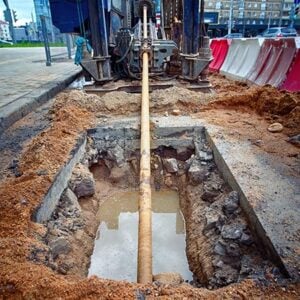 Geometry and pipe stress calculations are only part of the design. Before bidding, teams also need to know where equipment and pipe can be staged, how crews will access the site, how traffic and drilling fluid will be managed, and what contingencies are practical. If those questions remain open, the contractor may face restricted staging or equipment options, late alignment changes, and greater construction risk.
Those same constructability questions should shape contractor selection and construction oversight. Owners should weigh demonstrated qualifications and experience with similar installations alongside price, then clearly define construction standards, monitoring and response procedures, and oversight responsibilities in the project requirements.
Knowledgeable staff or a qualified engineer should remain involved to review the site and contractor plans, evaluate field changes, and maintain communication. This oversight helps the team plan and carry out the work safely. Establishing that continuity early helps the project team anticipate problems, identify when additional safeguards are needed, and reduce the risk of failures, damage, delays, unexpected costs, environmental impacts, and harm to public confidence.
These considerations are especially important for water mains, wastewater force mains, reclaimed water systems, and other critical infrastructure crossing developed or environmentally sensitive areas. During construction, continued design-team involvement gives the owner a way to assess field-driven changes against operating needs, environmental constraints, and the risks established during design.
Long-Term Performance Defines HDD Success
For utility owners, a successful HDD installation is not defined by pullback alone. It must perform as intended over time, protect existing assets and environmental resources, limit disruption to the community, support operations, and keep risk to the utility within acceptable limits.
At GAI, utility, geotechnical, environmental, permitting, and construction-phase specialists work together early, so route, risk, and constructability decisions can accurately reflect the utility’s operating needs. That coordination keeps viable options open and carries design assumptions into construction, where field changes can otherwise undermine them. The drill rig may be the most visible part of an HDD project, but long-term performance is largely set before it arrives.
Contact David Landing, PE, 904.559.8085, for more information about GAI’s civil engineering services including HDD for utility infrastructure. Message GAI and start the conversation about how our multidiscipline professionals can meet your unique project needs.
David Landing, PE supports water, wastewater, and utility infrastructure projects, focusing on pipeline design and trenchless installations. With nearly 30 years of experience, he manages projects from planning and feasibility through design, permitting, and construction support, helping clients address complex routing, constructability, and regulatory challenges.