Data Center / Mission-Critical Facility Commissioning
What It Is, Why It Matters, and Why Owners Cannot Afford to Get It Wrong
Data center / mission-critical facility commissioning requires more than testing. It requires validating the performance of integrated power, cooling, and control systems under real operating conditions. In mission-critical environments, this validation confirms systems will perform as intended before they are relied upon in operation.
At GAI, we apply that understanding to how we deliver data center / mission-critical facility commissioning. We go beyond verifying individual components to evaluate how systems perform together, drawing on experience across power, infrastructure, and building systems.
The Problem With “Turn It On and Hope”
Every data center / mission-critical facility shares one defining characteristic: failure is not an acceptable outcome. The consequences of an unplanned outage extend well beyond the cost of repair. Service-level agreements are breached, regulatory filings are triggered, reputational damage occurs, and, in the most serious cases, personnel safety, equipment integrity, or critical research data can be placed at risk.
While the industry continues to evolve toward robust commissioning, research data shows that around 78% of operators say their most recent outages were preventable, pointing to persistent gaps in management and processes. When these facility failures are investigated, the findings rarely indicate defective equipment, but rather startup and operational issues: a generator that fails to start, an uninterruptible power supply (UPS) that does not transfer cleanly under load, a chiller that trips offline at peak demand, a building management system that registers an alarm but never escalates it. In each case, the equipment may have been specified, purchased, and installed correctly; however, what was missing was a structured, independent process to confirm that those systems operate together before the facility goes live.
That design-to-operation review process is called commissioning. For owners, developers, and operators, data center / mission-critical facility commissioning is not optional. With recent industry research revealing that the average cost of unplanned downtime has reached $540,000 per hour, data center / mission-critical facility commissioning represents one of the most effective risk-reduction investments an owner can make before occupancy and operation.
Commissioning is not an added cost. It is what allows every other investment in a mission-critical facility to perform as intended.
What Commissioning Actually Is
Commissioning, abbreviated Cx in industry usage, is a systematic and documented quality process that verifies that a facility’s systems are designed, installed, tested, and capable of being operated and maintained in accordance with the Owner’s Project Requirements (OPR). It is not a single inspection or a checklist performed at the end of construction. When done correctly, data center / mission-critical facility commissioning begins in pre-design and concludes only after the owner’s operations team has formally accepted every system in the facility.
Complex capital projects typically include “owner’s engineering” or formal peer reviews of engineering deliverables to improve quality and reduce design risks. However, commissioning is often treated as an afterthought or limited to a final inspection. In practice, commissioning should not replace the engineering peer review process. Instead, commissioning should be integrated into the design phase, complementing engineering efforts and helping to reduce startup and operational issues.
The industry standard that defines this process is Guideline 0, published by the American Society of Heating, Refrigerating and Air-Conditioning Engineers (ASHRAE). Guideline 0 establishes commissioning as a full project-lifecycle activity organized around defined phases, deliverables, responsibilities, and acceptance criteria for each phase. For data centers and other mission-critical facilities, this framework is the foundation of every credible commissioning program.
The Commissioning Lifecycle, From OPR to Final Report
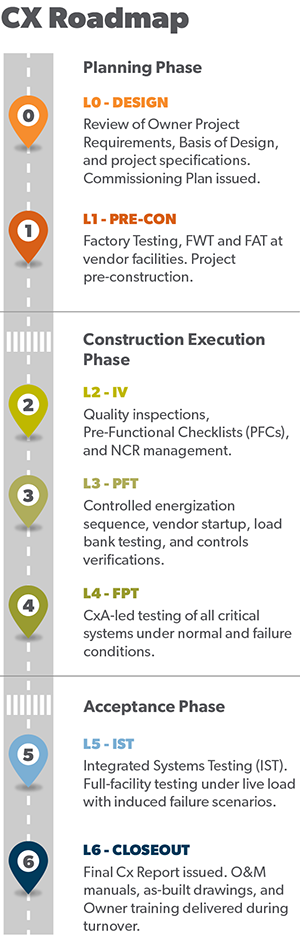 One of the most important principles in commissioning is that quality cannot be inspected into a project at the end, it must be built in from the start. ASHRAE Guideline 0 organizes the commissioning process into phases that parallel the project-delivery lifecycle. In data center / mission-critical facility commissioning, these phases are commonly referred to as Level 0 through Level 6, each representing a project stage with corresponding commissioning activities.
Level 0 — Design Phase
Commissioning begins with the development of the OPR, which defines required performance and acceptance criteria. The OPR establishes the baseline against which design, construction, and testing decisions are measured. The design engineer then produces a Basis of Design (BOD) document explaining how the proposed solution will satisfy each OPR requirement. The Commissioning Authority (CxA) reviews both documents and audits the construction documents at each design milestone, confirming that the original intent is translated into drawings and specifications.
Level 1 — Pre-Construction
Before construction begins, the commissioning program is formalized through a Commissioning Plan. This governing document defines the scope of commissioning, the roles and responsibilities of every project participant, the schedule of commissioning activities, and the standards by which systems will be tested. Critical equipment is reviewed in the supplier’s manufacturing facility through factory witness testing (FWT) or factory acceptance testing (FAT), during which the CxA witnesses performance testing before the equipment ships to the site. Issues identified at this point cost a fraction of what they would cost to resolve after installation.
Level 2 — Installation and Verification (IV)
As construction commences, the commissioning program shifts to field verification. Detailed IV checklists are developed for each equipment type and completed by the installation contractor and equipment supplier, then independently verified by the CxA. A formal foreign object debris (FOD) inspection and clean & close program is executed in critical spaces before energization is authorized. Non-conformance reports (NCRs) are issued for identified installation deficiencies, including root cause, corrective action, and reinspection. Nothing is energized until verified.
Level 3 — Energization and Startup – Pre-Functional Tests (PFT)
Systems are energized in a controlled, sequenced manner. Equipment supplier startup procedures are executed and verified. Control systems, including Building Management Systems (BMS), Data Center Infrastructure Management (DCIM), and Electrical Power Monitoring Systems (EPMS), are programmed and undergo initial point-to-point verification, all with the CxA present to witness and document the PFT process. Load bank testing confirms generator and UPS performance under rated load conditions. In data center practice, the successful completion of Level 3 commissioning activities is equivalent to Substantial Completion in standard construction contract language.
Level 4 — Acceptance Phase – Functional Performance Tests (FPT)
This is the phase during which systems are formally proven to perform as designed. FPTs are executed for each commissioned system to verify normal operation and response to defined failure modes, alarm conditions, and control sequences. Generator automatic transfer sequences are timed and documented. UPS redundancy failover is verified under load. Chiller plant sequences are exercised through defined operating modes. BMS and EPMS alarm routing are confirmed against the owner’s alarm matrix. Deficiencies identified during FPT are tracked in the Commissioning Issues Log and resolved before owner acceptance is granted.
Level 5 — Integrated Systems Testing (IST)
Where FPTs verify individual systems, the IST verifies full-system integration under true operating conditions. The IST simulates real-world failure scenarios such as utility loss, generator failure, UPS failure, chiller failure, and cooling failure, with all systems operating under representative load. For data centers, the IST also confirms that the facility maintains ASHRAE A1 thermal class conditions during these scenarios, making sure that no server inlet temperature exceeds shutdown thresholds. IST is the final proof that a facility is ready for live operations and represents the culmination of data center / mission-critical facility commissioning.
Level 6 — Closeout and Turnover
The commissioning process concludes with the formal delivery of a Final Commissioning Report. This report documents the tests performed, the issues identified and resolved, and the project’s compliance with OPR requirements. Operations and maintenance manuals are reviewed for completeness, the commissioning report is finalized, computerized maintenance management system (CMMS) data is populated, and the owner’s operations team receives formal training on commissioned systems. Seasonal and deferred commissioning items are scheduled and tracked. The facility is then transferred to the operations team.
Who Performs Commissioning, and Why Independence Matters
One of the most important distinctions in commissioning practice is the difference between the CxA and the construction team’s internal quality program. Both share the goal of delivering a quality product to the owner. The CxA, however, works on behalf of the owner to facilitate and document that quality has been achieved.
The CxA is an independent, third-party professional engaged directly by the owner. The CxA has no financial interest in the outcome of construction and is responsible solely for verifying that the owner’s requirements are met. The CxA develops the commissioning program, conducts independent verification of installation and testing activities, maintains the Commissioning Issues Log, and ultimately issues the Final Commissioning Report that documents the owner’s acceptance of the facility.
This independence is not a formality; it is the entire point. A contractor or equipment supplier verifying its own work is not commissioning. Commissioning is the independent third-party validation documented against the OPR by a qualified CxA. The distinction is what gives the Final Commissioning Report its value.
In parallel with the CxA program, the general contractor and MEP subcontractors maintain their own quality programs, executing pre-functional checklists, managing NCRs, coordinating vendor startups, and supporting functional testing activities. A well-integrated project has both programs working in alignment, with the general contractor’s quality team driving construction-phase compliance and the CxA providing independent oversight and owner-facing documentation throughout.
What GAI Brings to Data Center / Mission-Critical Facility Commissioning
At GAI, we approach data center / mission-critical facility commissioning as a disciplined, lifecycle-driven quality process grounded in ASHRAE standards and informed by our experience in complex power and infrastructure systems. Our focus is on helping owners transition from construction to confident, resilient operations.
GAI’s commissioning professionals bring direct experience across new construction, campus expansion, and live retrofit programs, including projects delivered to major cloud infrastructure providers under owner-proprietary commissioning standards. Our approach is built on a straightforward principle: the owner’s requirements are the standard, independence is non-negotiable, and documentation provides the owner with a defensible record of that validation. GAI’s commissioning programs produce a comprehensive project record that gives owners confidence in their facility from design through the start of operations.
For today’s owners, the question is no longer whether to commission, but whether their data center / mission-critical facility commissioning program is rigorous enough to manage real operational risk.
Contact Commissioning Program Manager Patrick Stanczyc, 321.319.2510 for more information about GAI’s commissioning and MEP QA/QC services for data center and mission-critical projects.
Read more from GAI’s Data Center / Mission-Critical Facility Commissioning team:
 Patrick Stanczyc leads a team dedicated to supporting mission-critical power and energy projects with a focus on commissioning strategy, program delivery, and risk mitigation for complex facilities. He brings more than a decade of experience leading commissioning and MEP construction programs for hyperscale and colocation data centers, and has built a reputation for operating effectively in high-risk, schedule-compressed environments while balancing technical requirements, field execution, and client priorities.