Bridges are vital infrastructure components that link communities, support local economies, and provide broader regional connections. Over time, traffic loads, weather, and environmental conditions take a toll. As a cost-effective alternative to full bridge replacement—often because public funding gaps make large capital projects unrealistic—rehabilitation provides a smart, efficient way to extend a bridge’s service life. It also delivers simultaneous benefits in safety, travel reliability, and long-term economic value for the surrounding community.
“GAI approaches every bridge rehabilitation project with the goal of extending the service life of our clients’ bridges by 50 years or more,” said Benjamin Allis, PE, GAI VP and NE Transportation Business Sector Leader. “The objective extends beyond repairing damage to restoring the bridge’s long-term structural reliability.”
What Bridge Rehabilitation Involves
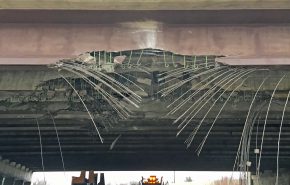
GAI engineers begin by evaluating each major bridge component—its condition, remaining service life, and role within the structure. Concrete foundations and substructures often remain serviceable with targeted repairs or protective treatments. Other elements, such as bearings, steel superstructures, and bridge decks, experience more severe wear, especially in cold climates or coastal areas where freeze-thaw cycles, deicing chemicals, and salt exposure accelerate deterioration.
As steel bridges age, fatigue-prone details may begin to show cracking after decades of repeated traffic loads. To address these issues, GAI refines load paths, adjusts stiffness where appropriate, and strengthens connections that tend to collect stress. These improvements help reduce cracking and extend the useful life of the steel superstructure.
When traffic demands increase, GAI applies strengthening techniques to improve load-carrying capacity. Phased construction plans help keep bridges operational throughout the work, and the team places emphasis on minimizing closures and maintaining access for travelers, local businesses, and nearby neighborhoods. When historic elements are part of the structure, GAI collaborates with owners and preservation groups to retain or reuse defining architectural features.
A Clear Process From Assessment Through Construction
Every rehabilitation project starts with a review of existing plans, previous load ratings, maintenance records, and detailed field inspections. These steps help the team understand deterioration patterns and focus repairs where they will provide the most long-term benefit.
GAI then works closely with clients to evaluate recommended strategies. This collaboration includes reviewing cost considerations alongside right-of-way needs, environmental constraints, construction duration, and year-round access for businesses, schools, and emergency services. Additional discussions center on phasing options, community impacts, and opportunities to limit service interruptions. The result is a rehabilitation plan tailored to both the structure and the people who rely on it.
Once the scope is defined, GAI prepares contract drawings and specifications for construction. During the build phase, engineers stay engaged by reviewing contractor submittals, responding to field questions, and ensuring that work reflects the design intent. At project closeout, the team compiles final as-built drawings and organizes design and construction records for integration into the client’s bridge management system, supporting long-term planning and future maintenance decisions.
GAI’s Bridge Rehabilitation in Practice
- Panhandle Bridge – Pittsburgh, Pennsylvania
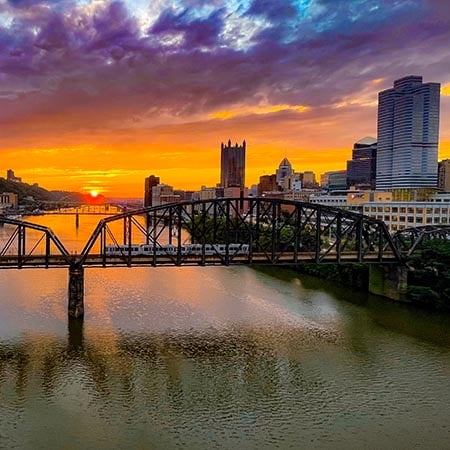 GAI’s Pennsylvania Structures team recently completed the rehabilitation design for Pittsburgh Regional Transit’s (PRT) Panhandle Bridge, a system of three connected spans originally built in 1910 and converted to light rail in 1984. The bridges carry three active rail lines between downtown Pittsburgh and the South Side, making safety and continuous operation a major priority. GAI’s decades-long relationship with PRT—including routine and emergency inspections—helped the team develop solutions that matched system needs and operational realities.Key drivers for this project included deterioration of the protective paint system, section loss in steel load-carrying members, miscellaneous steel and concrete repairs, and the need for improved navigational and pedestrian lighting. Before developing alternatives, GAI gathered input from PRT staff and project stakeholders to clarify operational requirements and construction challenges. While cost was a factor, keeping everyone safe was key as these high-volume bridges were to remain operational throughout construction, with crews working near active traffic and rail lines. “PRT wanted to complete the project in two construction seasons,” said GAI Senior Project Manager Mike Beresford, PE, CBSI. “GAI addressed this by providing a detailed construction schedule and maintenance-of-traffic (MOT) phasing plans that supported continuous operations.”As design reached the 60% stage, the scope expanded to include a new auto-tensioning catenary system, rail replacement, and decorative lighting along the river spans. Despite the added elements, the team stayed on schedule. The project was advertised in November 2025 for approximately $72 million, with the winning bid coming in roughly 20% under budget. Construction is expected to begin in January 2027.
- Park Avenue Viaduct – Yonkers, New York
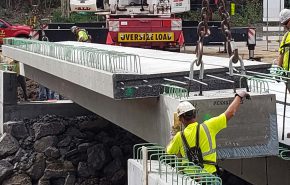
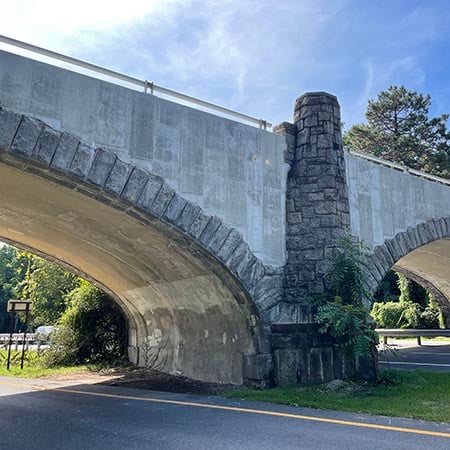 Creighton Manning, a GAI Company, led the rehabilitation of the Park Avenue Viaduct, a historic two-span concrete arch bridge carrying Park Avenue over the Bronx River Parkway and the Bronx River Pathway. Because of the structure’s age and architectural character, coordination with the New York State Historic Preservation Office (SHPO) and Westchester County’s Historic Preservation Advisory Committee (HPAC) played an essential role.“The Bronx River Parkway is a national historic place, and multiple agencies work hard to protect its historic integrity,” said GAI/Creighton Manning Project Manager Tim Cremins, PE. “Our collaboration helped ensure the design respected that history while improving long-term performance.”Early inspections revealed unstable fascia stones, prompting emergency stabilization and a detailed evaluation of the concrete arch. A Level 1 load rating confirmed the rehabilitation needs. Planned improvements include cataloging and reinstalling original stonework, waterproofing the arch tops, constructing new reinforced concrete spandrel cores with integrated slabs, and upgrading buried utilities. Construction is currently underway.
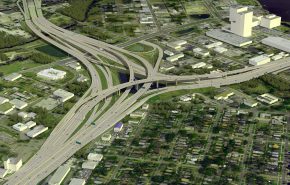
Beyond the Northeast, GAI has helped deliver major bridge rehabilitation projects including the Fuller Warren Bridge in Jacksonville, Florida, the Tannehill Road Superstructure Replacement in Bartholomew County, Indiana, and the WV North 77/79 Bridge Bundle in West Virginia—each project demonstrating the firm’s ability to meet complex technical requirements while supporting client goals and community needs.
Strengthening Structures Communities Depend Upon
Every bridge plays a role in how a community functions—from supporting local businesses and emergency access to shaping daily travel for residents. Through rehabilitation strategies that enhance safety, preserve mobility, and strengthen long‑term reliability, GAI helps clients protect infrastructure that people depend on every day. By focusing on durability, thoughtful design, and construction approaches that limit disruption, we help make sure essential crossings remain reliable links that support community life, economic stability, and regional growth for years to come.
Contact Ben Allis, PE, 412.399.5100, Mike Beresford, PE, CBSI, 412.399.5326, or Tim Cremins, PE, 518.689.1845, for information about GAI’s transportation structures services. Message GAI and start the conversation about how our multidiscipline professionals can meet your unique project needs.
Benjamin Allis, PE specializes in the design, analysis, construction engineering, and project management of structural transportation projects for both new and rehabilitation structures. Ben has provided services for an array of transportation clients, including departments of transportation, toll authorities, private authorities, and contractors.
Michael Beresford, PE, CBSI specializes in project management, bridge design and rehabilitation, structural analysis, and inspection of transportation-related structures. His inspection experience includes steel truss bridge major river crossings, pre-stressed concrete bridges, steel box girder bridges, timber bridges, sign structures, deep manholes, inclines, and tunnels.
Timothy Cremins, PE is responsible for the design of new bridges, bridge rehabilitations, construction engineering, contractor support services, and preparation of design reports. Tim leverages a substantial background in construction, bridge inspection, drafting, client coordination, calculation preparation, permitting, materials testing, and more to support a range of transportation initiatives.